DataGerry is open source. It has been from the very beginning, and it will remain so. So far, we’ve offered the free community version and a SaaS option in the cloud. Now we’re adding a third option.
Today, we’d like to openly share with you what’s next for DataGerry—and why we’re taking an additional step that’s important for the community to understand: DataGerry is getting a new edition—and this one is crucial for many of you: DataGerry Self-Hosted Edition.
An Overview of the Content:
Why We’re Taking This Step
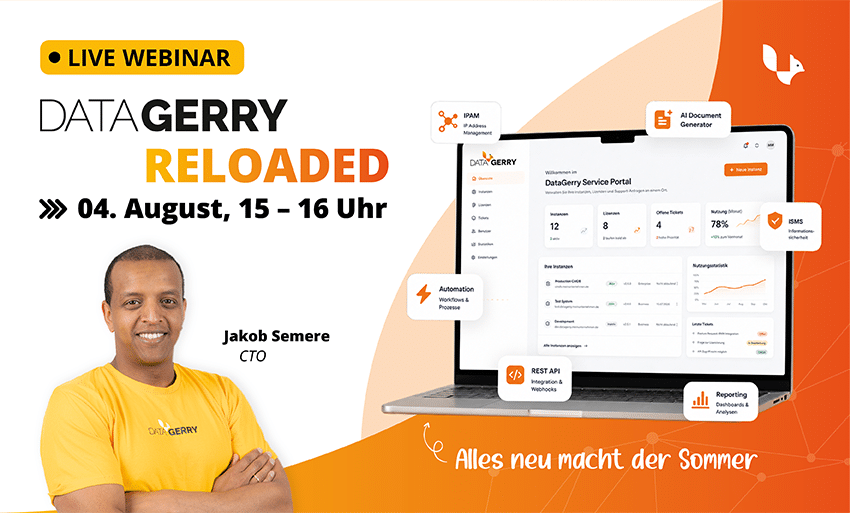
DataGerry has grown significantly in recent years. What started as a flexible open-source CMDB has evolved into a platform that now also covers ISMS, automation, reporting, an AI-powered document generator, IPAM, and a visual CI explorer. We owe this development in no small part to the community: your feedback, your requests, and your trust.
At the same time, we have to be honest. Developing, maintaining, testing, and documenting a platform of this complexity is work that is done by people—by a team that needs to be able to make a living from it. So far, we’ve made nearly the entire feature set freely available. That was a deliberate decision aimed at establishing DataGerry’s broad appeal. However, it has also meant that the professional development of the platform isn’t being sufficiently supported financially.
If we want to continue improving DataGerry’s quality over the long term to meet your expectations, we need a sustainable model. That’s exactly why we’re introducing the DataGerry Self-Hosted Edition.
What Won’t Change for the Open-Source Community
First things first: The Community Edition of DataGerry remains free, open, and fully functional. It is not a limited demo, a gimmick, or a stopgap solution. It remains a full-fledged CMDB platform.
Among other things, the following are included:
- Unlimited assets
- CI-Explorer
- Import and Export
- Backup and Recovery
- Reporting
Manage configuration items, map relationships, capture data in a structured way, and visualize dependencies within the IT landscape—all of this is and will continue to be possible with the free version.
What Complements the DataGerry Self-Hosted Edition
The DataGerry Self-Hosted Edition bundles advanced features that are primarily used in production, integrated, and compliance-related environments:
- ISMS
- IPAM
- Document Generator (AI-powered)
- Automation, REST API, and Webhook Integration
These features are designed for organizations that want to use DataGerry not only as a CMDB, but also as a central foundation for information and automation in IT and security processes. It is precisely in this area that requirements arise which we can only responsibly meet if these features are commercially supported.
ISMS and Risk Analysis
The ISMS module links information security directly to the CMDB data. Risks can be assessed in the context of assets, object groups, or risk scenarios—including probability of occurrence, impact, risk level, and defined responsibilities such as Risk Assessor and Risk Owner.
This creates a robust, traceable data foundation, particularly in the context of ISO 27001, BSI IT-Grundschutz, or NIS2. Security-related information is not maintained in isolation but is directly linked to the underlying configuration items.
IPAM
IPAM supports the structured management of networks, subnets, and IP addresses—and links network resources to devices, locations, services, and responsibilities.
The graphical representation of network areas and their relationships in CI Explorer also provides a quick and intuitive overview of address spaces, allocations, dependencies, and available capacity.
Document Generator
The Document Generator creates structured, AI-powered documents—for audits, internal approvals, management reports, or technical documentation. This reduces manual effort and ensures that information is available in a consistent and traceable manner, especially in environments with high documentation requirements.
Automation and REST API
The REST API opens up the CMDB to external systems, scripts, and integration platforms. Webhooks enable event-driven communication, such as when objects are created, modified, or deleted. Automation complements this approach by enabling recurring workflows to be implemented more efficiently based on existing data. DataGerry thus becomes not only a documentation solution but also an active data source for operational IT processes.
What does this mean, specifically, for existing users?
Anyone currently using DataGerry as a free CMDB can continue to do so without any changes. The core features for object management, data modeling, CI relationships, and import/export remain part of the free version.
Organizations with more advanced requirements will now have the option, with the DataGerry Self-Hosted Edition, to use additional modules via a subscription—ISMS, IPAM, the AI-powered Document Generator, Automation, and REST API. In addition, installation and support packages remain available for purchase, providing assistance with getting started, setup, architecture questions, and best practices.
Open at its core, professionally expandable
We know that any change to an open-source project raises questions. And we take these questions seriously. That’s why we want to be clear: The introduction of the Self-hosted Edition is not a departure from the open-source philosophy, but rather our attempt to safeguard it.
Without a viable commercial model, we would not be able to continue developing the platform to its current depth. This new edition creates a framework that makes exactly that possible—while simultaneously ensuring that the open core remains freely available and usable by the community. For us, these two go hand in hand.
The community continues to benefit from an open core, transparent development, and a freely available CMDB foundation. Those who need additional features can nowaccess them through the various subscription tiers of the Self-Hosted Edition , depending on their specific requirements—and in doing so, help ensure DataGerry’s long-term sustainability.

Conclusion
With the DataGerry Self-Hosted Edition, we’re clarifying our model. The free open-source version remains the open, full-featured CMDB foundation. The tiered Self-Hosted Subscriptions supplement it with advanced features for ISMS, IPAM, the AI-powered Document Generator, API integration, webhooks, and automation.
We believe this step is necessary—and that, if implemented correctly, it will make both possible: a robust, freely available Community Edition and a platform that can continue to be developed professionally in the years to come.
We would like to thank the community for its trust and support over the past few years. Your feedback on this step is important to us—please feel free to reach out to us.
DataGerry Webinar
Day(s)
:
Hour(s)
:
Minute(s)
:
Second(s)
Sign up for free now